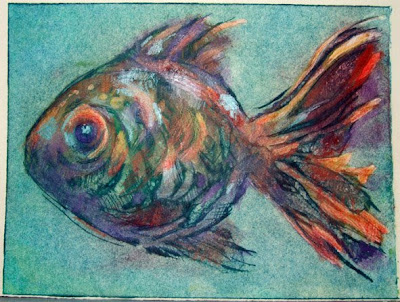
Fish 1, collagraph and coloured pencil, 9x7 ins, Vivien Blackburn
Whilst sorting through old work to store in my lovely shiny new plan chest I came across unfinished pieces that were worth working further on - these 2 collagraphs were put in the 'To Work On And Finish Later' drawer.
This morning I got out the coloured pencils and added just a few thin glazes of colour to push the colour range a little and add warm and cool variations. Polychromos pencils work beautifully over the printing inks on Fabriano Rosapina paper.

Fish 2, collagraph and coloured pencil, 9x7ins, Vivien Blackburn
Collagraphy is a printmaking process - in this case the 'plate' was the card used for the mats in picture framing. The lines are simply cut into the surface with a craft knife, the darker areas are where the top surface has been peeled away, leaving a fuzzy surface. The lighter areas are where PVA glue has been painted on - this repels the ink and makes it easy to wipe it off.
Before printing, it is varnished with Shellac, a meths based varnish. Oil based varnishes would melt when the ink was applied and the plate would get soggy and disintegrate.
The the ink is applied and rubbed in to the cuts and wiped off the surface to leave a thin veil of ink - at this stage it's quite creative and no 2 prints will ever be the same. The way the ink is wiped off and the colour applied is like monoprinting.
Then the plate is printed using an etching press - the high pressure is needed to force the ink out of the grooves.
The lines print darkest as the grooves hold the ink, the peeled away sections are next in darkness or intensity, the smooth untouched surface can be wiped so that it is as pale as you want and the pva sections are very pale.
Applying the ink isn't a totally accurate process so the finished result has a looseness that I like, held together by the incised lines. It isn't possible to use many colours of ink at once either - the second print was simply a deep blue ink and a yellow ink blurred and blended where they met (plus the touches of coloured pencil done later).
I really like the moment when you peel your print away from the plate and find out what you have :>) I do want an etching press of my own.
Some people stick lace and textured things onto the plate - but for my work I find this a little crude and coarse. I do sometimes use fine threads or fabrics but nothing too clunky. These hold the ink differently and create intersting textures that are indented into the paper of the final print.
Another method that I mean to try sometime is one I've read on someone's blog - and I apologise to you but I can't remember who the blog belonged to! If you recognise yourself please leave a message and a link? Anyway, they collaged flat pieces of card/whatever and inked up the plate, wiped it - leaving the ink puddled around the edges of the collaged pieces, and then printed it by hand rubbing it, giving outlines from the shapes used. It is possible to hand print with this technique because there is no intaglio involved (intaglio=cut into the surface marks holding ink) - intaglio processes like etching need high pressure to print, for relief processes, where the ink is on the surface, it is possible to print my hand - though a press makes life easier and I like the way it prints better. I want an etching press!
Do you do any printmaking? if so what do you do? do you have an etching press?
Tomorrow an update on the sketchbook exchange ........
http://flyingpictures.wordpress.com/ link